
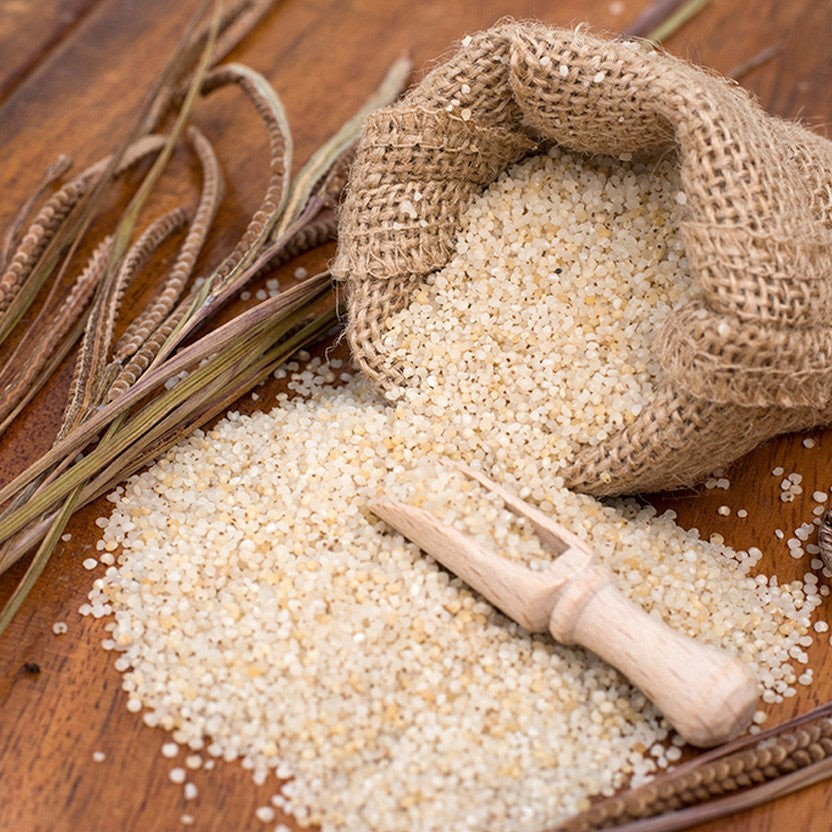
Barnyard Millet is a small white-shaped seed that grows naturally in Uttarakhand, India. It includes more nutrition than other cereal grains and is a great source of protein, carbs, and fibre. This can be provided to 6 to 8-month babies as gruel or Kheer, and to kids above one year as dosa and idlis. It is recognized as “Sanwa Rice” but when boiled, it makes it taste almost like rice. It is grown in areas where the land is unsuitable or the climate too cool for paddy rice cultivation. The crop plant is a tall, robust annual and grows up to 220 cm high. It has a short generation time, fastest growth among all small millets and completes the life cycle from seed to seed in 45–60 days.
REGIONAL NAMES
•Kuthiravali in Tamil
•Odalu in Telugu
•Jhangora in Hindi
•Kavadapullu in Malayalam.
BENEFITS
Beneficial in Cancer
It is helpful in reducing cancer of the ovaries and uterus. Regular consumption of this reduces the risk of cancer. By taking a diet made of savanna, it protects us from ulcer formation in the small intestine and cancer of the liver and spleen of the large intestine.
Helps relieve constipation
Barnyard millet contains a decent amount of both soluble and insoluble fiber. Dietary fibers leave the body in the same way as they are eaten. And consequently, they help in the digestion and excretion of waste materials. Grains have always been seen as constipation relievers. Thus barnyard millet is one of the best things to eat if a person is suffering from constipation.
Strengthens Immune System
Barnyard millets contain a reasonable amount of iron and zinc. Both zinc and iron are essential for our immune system. So, ultimately, eating barnyard millets benefits the body to deal with invading substances and infections.
Rich in Fibre
It is an excellent source of dietary fiber with a good amount of both soluble and insoluble fractions. The grain encompasses the highest amount of fiber in comparison to other grains and millets with a serve providing 2.4 grams of fiber. According to a study published in the Journal of Food Science and Technology, the dietary fiber content of barnyard millet was high (12.6%) including soluble (4.2%) and insoluble (8.4%) fractions. The high fiber content helps in preventing constipation, excess gas, bloating and cramping.
Gluten-Free Food
Like all millets, the barnyard millet is gluten-free. It is an appropriate food for patients who are intolerant to gluten (those with celiac disease) or looking to follow a gluten free lifestyle which eliminates wheat, barley, rye-based foods. The millet being easily available, quick to cook and good to taste proves to be an ideal wholesome alternative to rice, wheat and other less easily available millets.
Good Source of Iron
According to research on nutrient content on millets, some varieties of barnyard millet have shown to contain high amounts of iron (18.6 mg in 100g of raw millet) which was the richest amongst all millets and cereal grains. Barnyard millet could be a good source of iron for vegetarians.
Low in Calories
Barnyard millet is a good source of highly digestible protein and at the same time is least caloric dense compared to all other cereals. It is a grain which makes one feel light and energetic after consumption. A serving of barnyard millets (25g, raw) gives 75 calories and 1.5g of protein.
Low Glycemic Index
The carbohydrate content of barnyard millet is low and slowly digestible, making the barnyard millet a low glycemic index food. The carbohydrates in millet show a high degree of retrogradation of amylase, which facilitate the formation of higher amounts of resistant starch. Hence, it can be potentially recommended for patients with cardiovascular disease and diabetes mellitus. In today’s scenario, this millet becomes one of the ideal foods for diabetics.